

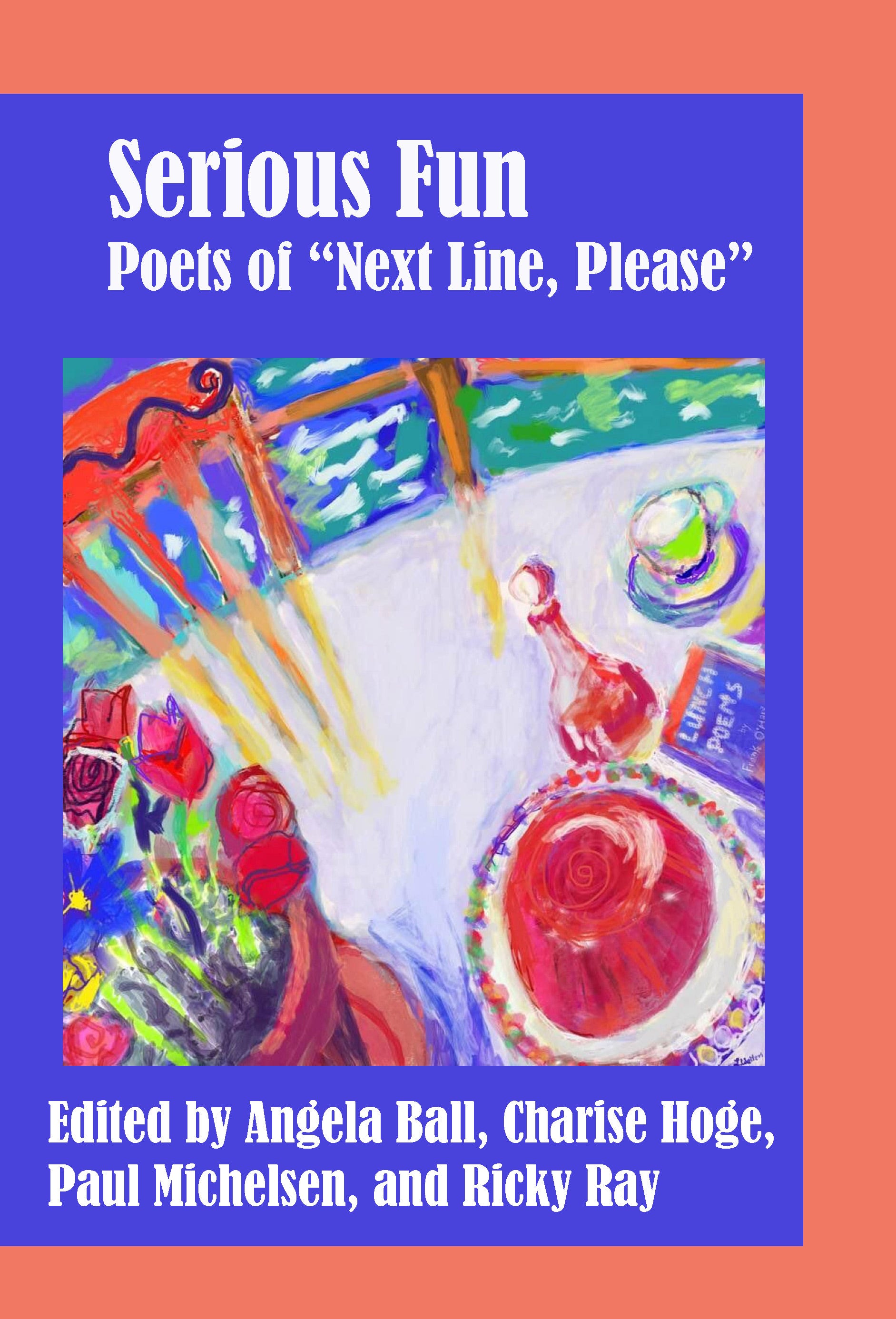
Yes, there will be a Zoom poetry reading and discussion this Saturday featuring readers from an online writing group led by noted poet, critic, and editor David Lehman. It’s a book party for the publication of Serious Fun (Zeitgeist, 2026), a new book of poems from that writing group, known as Next Line, Please. Our strong open reading will follow the feature. Click on the link below at the appointed time to join.
Poetry Reading & Discussion, Saturday September 19, 2:00 PM PDT
To Join by Telephone: (669) 444-9171
Meeting ID: 840 4579 5179
Some of you will recall David Lehman from his 2017 visit to Las Vegas, where he read poems and gave a talk on Bob Dylan in literature. Readers may know David Lehman from his years editing the popular Best American Poetry books published annually. The poems in our book include a pleasurably whimsical New York School flavor. Our friend, editor, and excellent poet Paul Michelsen brought this book to Zeitgeist and helped arrange its publication. As the title of the book says, the poems are fun and also serious writing. Here is one such poem from the book by Paul:
At Times Your Name

At times we’re thrown from the sky into the water
At times we’re thrown from the sky into the cold,
brown ground spattered white with stars
At times we are given glimpses of miracles
We feast our eyes on half-cooked plans
from the easy-bake oven mind
of a little girl’s made-up god
At times we put on tap shoes and go to town on marble floors,
find ourselves barefoot, unforgiving
At times we reach for mothers who aren’t there,
put on a life vest, only to be told we are dead
At times we think truth is rude,
especially opinions,
others’ feelings
The deep dark thoughts of friends
hurt worse than enemies
At times it hurts to hear
pronounced, with undeniable clarity,
your very own name.
~
Here’s a poem below that illustrates the title of the book by Christine Rhein, a former automotive engineer, who says the workshop generated more than 60 poems for her.
Occupational Hazards

One coffee after another. Two bosses.
             Three days to corporate reorg,

worldwide meetings, four or five hundred
             PowerPoint slides you need

to start drafting. That smile—6 PM,
             at your desk—Boss A stopping by

while buttoning his coat: Remember,
             it's all about moving the goalposts.

At 7, Boss B: It's all about moving
             up the ladder. We’re counting

on you to work your magic. Eight times
             nine columns, rows, ways

a spreadsheet can be skewed. Ten o'clock =
             dinner deleted. 11:30 = bedtime =

your pillows propping the laptop + its steady
             overheating + your nightstand printer

running out of black. Twelve years
             and counting. One life. One life.
~
Here’s a poem by Emily Winakur, working as a psychologist when the writing group caused this memorable first line to pop suddenly into her mind.
Conceit

Poetry is larceny, from start to end:
the sleight of hand at work, slipping
seconds from under bosses’ body parts;
picking pockets for other people’s words.
The deceit of being loving while assembling
in your mind, as though from a forest grotto
or beach cave stash, the poem. And then
you’ll try to pawn it as your own.
~
I love these brief pointed poems like the one below, by Elizabeth Solsburg.
Love and illusion

It is impossible to love the same person twice.
In seven years, you are both completely replaced,
every cell dying and then resurrecting
until the person you are today is erased.
Is love encoded in these renewed molecules;
do you meet again as strangers with familiar faces
whose tenderness has calcified like limestone grave
markers, blurry engravings of the resting place
of illusion—the memory of the person
you are certain you knew once in the far away—
where love is so solid you stumble and fall,
and thought is as real a thing as a cannonball?
~
Charise Hoge is one of the editors of the book. Her poems include this priceless tale, laid out in a few short words with rhythm and graced.
What I Wanted to Be When I Grew Up

I wanted to be
what I wanted, when I wanted.
When I wanted to be wanted,
I grew up.
~
Donald LaBranche is a lover of poetry in the American vein. This poem has that memorable train-of-thought thread of the best New York School verse.
The Willow

That willow tree was a home run, the center mast                                                                                                   And crow’s nest of the Pequad. It was Everest.                                                                                                   It’s roots a jumble of above and below like prayers.
A jumble of above and below, very much like                                                                                               The Mass in that predawn dark and cold chapel where                                                                                   Father often got lost singing the prayers.
Are the dead just the dead? Or scattered wide across                                                                                           The ground underneath the willow, gnarled like old                                                                                  Knuckles; in the way like inconvenient prayers.
I’m often unsatisfied when things go well. But                                                                                              I’m glad I’ve read Yeats when the center doesn’t hold.                                                                                          It would do me good to hush-up during prayers.
Like badgers, children burrow under the jumbled roots.                                                                                    They listen for secrets the willow might tell, or                                                                                            Endure the biting of ants on their way to prayers.
Like children, badgers dig into the dank roots and                                                                                                The fungus smell of the willow’s bark. Father Badger                                                                                      And his children sing naked and unbowed prayers.
~
LaWanda Walters writes fun seriously. Here’s one I particularly liked.
How a Poem Can Staunch a Wound

Writing it, finding some music or metaphor
which, on its own, takes surprisingly off—
the concept distracting like a balsa-wood frame
that can lift from the earth for a while, glide through
insect territory, blue-green wings netted like tutus,
the tremulous fireflies’ lemony bulbs, wavering,
near-sighted in the arbitrary, tall, dangerous air
which also carries a radio-control tower’s terrifying
signals, the sand in the eye, the body preoccupied
by flight, the dark speed outside an oval window,
the passengers’ comfort, pillows for their necks
and the necessary, whistling air pressure—
I can feel, sometimes, elated.

But for a time the old master, Walt Whitman,
did the impossible, walked on the ground,
muddy, in Washington, let go, completely,
his tissue-paper poems. His mind got soaked
with the bright blood on the grass everywhere,
too many for the hospital so they set up tents,
a young soldier’s face turned away not to look
at the stump, the free-spirited poet with his sleeves
rolled up to swab out the “offensive” matter.
Those young men who’d fallen as oddly as Icarus—
they sometimes kissed his bearded lips
and called him, gratefully, “Mother.”
~
Finally, here’s a poem by David Lehman that sticks with me.
The Pleasures of Peace

It's not just the absence of war, Scott said, but Hemingway
got the last word, and for decades driving an ambulance in
Europe in World War I was how you made your mark as a man.
Peace in those days meant Paris and a wound and an aperitif.
No sooner do I write those words than I visualize a rocks glass
with a big rock of ice in it and something sweet but not too sweet
like Byrrh or Cynar or Campari if you have a taste for it.
That aperitif is one of the true pleasures of peace. (There are false ones.)
So I go upstairs to see what we’ve got in my homemade bar
and I decide on three jiggers of ice-cold gin, a splash of dry vermouth,
with an onion and an ice cube to keep it cold, and I make two of them,
one for me, one for Stacey, and I sip my Gibson, not too fast,
and this moment is one of the pleasures of peace as I see it,
though nothing beats a summer afternoon, a book, a stream.


June 8, 2017
~
In these times of serious destruction and strife, I find whimsical reflections of New York School verse especially appealing. Let one of these poems serve as a model for you. Make it personal, make it fun, make it yours. Let the poem bring you to the reading. Or just bring whatever you’re reading or writing.
Hope to see you at Poetry!
We received a critical donation from Gray’s Leadership Academy. Our in-person workshops are supported by Clark County at Winchester Dondero Cultural Center. We also receive support from the good people at Clark County Public Arts and Clark County OAG. Thank you!Bruce Isaacson
Poetry Promise, Inc.
a 501 (c)(3) Corporation
Phone: (702) 205-7100
Bruce@PoetryPromise.org